Francis Scott Key was a gifted amateur poet. Inspired by the sight of the American flag flying over Fort McHenry the morning after the bombardment during the War of 1812, he scribbled the initial verse of his song on the back of a letter. Back in Baltimore, he completed the four verses and copied them onto a sheet of paper, probably making more than one copy. A local printer issued the new song as a broadside. Shortly afterward, two Baltimore newspapers published it, and by mid-October it had appeared in at least 17 other papers in cities up and down the Coast.
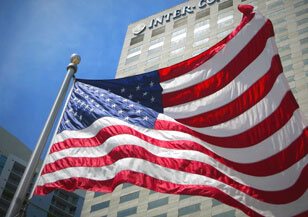
The War of 1812 conflict between the United States and Great Britain fueled a surge in patriotic songs and symbols. In September 1814, British forces bombarded Fort McHenry in Baltimore. Francis Scott Key, who was detained on a British ship, witnessed the attack. Key was deeply moved by the sight of the American flag, with its 15 stars and 15 stripes, still flying over the fort at dawn, signaling the fort’s successful defense. Key’s poem, inspired by the flag, was initially printed as a broadside (one sided paper) and then published in newspapers. It was later set to the melody of “To Anacreon in Heaven,” a popular English song. The song gained widespread recognition and was frequently played at military ceremonies and patriotic events in the 19th century. While widely regarded as the national anthem, it was not officially adopted as such until 1931, when President Herbert Hoover signed a bill into law.
The Star-Spangled Banner Lyrics
O say can you see, by the dawn’s early light,
What so proudly we hail’d at the twilight’s last gleaming,
Whose broad stripes and bright stars through the perilous fight
O’er the ramparts we watch’d were so gallantly streaming?
And the rocket’s red glare, the bombs bursting in air,
Gave proof through the night that our flag was still there,
O say does that star-spangled banner yet wave
O’er the land of the free and the home of the brave?
On the shore dimly seen through the mists of the deep
Where the foe’s haughty host in dread silence reposes,
What is that which the breeze, o’er the towering steep,
As it fitfully blows, half conceals, half discloses?
Now it catches the gleam of the morning’s first beam,
In full glory reflected now shines in the stream,
’Tis the star-spangled banner – O long may it wave
O’er the land of the free and the home of the brave!
And where is that band who so vauntingly swore,
That the havoc of war and the battle’s confusion
A home and a Country should leave us no more?
Their blood has wash’d out their foul footstep’s pollution.
No refuge could save the hireling and slave
From the terror of flight or the gloom of the grave,
And the star-spangled banner in triumph doth wave
O’er the land of the free and the home of the brave.
O thus be it ever when freemen shall stand
Between their lov’d home and the war’s desolation!
Blest with vict’ry and peace may the heav’n rescued land
Praise the power that hath made and preserv’d us a nation!
Then conquer we must, when our cause it is just,
And this be our motto – “In God is our trust,”
And the star-spangled banner in triumph shall wave
O’er the land of the free and the home of the brave.